
7 Archery Tag scenarios you absolutely have to try
Published on 21 July 2026, updated on 1 September 2026 by the Tag Brussels team
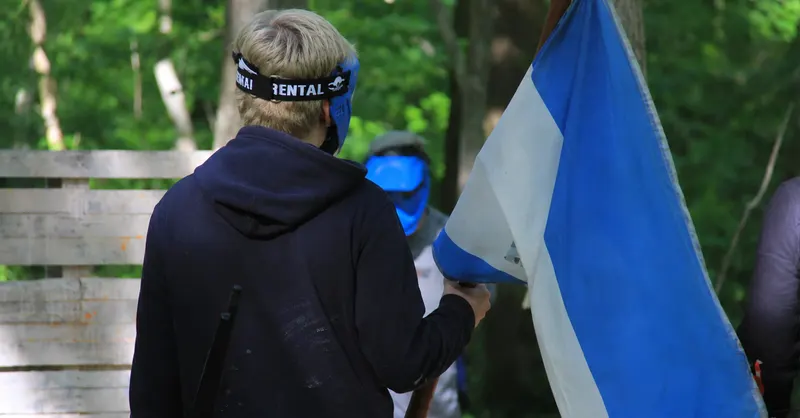
An Archery Tag session at Tag Brussels lasts 2 hours and packs in 5 to 8 rounds, covering 3 or 4 different scenarios: the classic elimination, capture the flag, protect the king, the medic, battle royale, the target assault and attack-and-defence. Here are our players' 7 favourites, with their rules and the tips our instructors share at the briefing, in our private 5-hectare forest in Bierges (Wavre). New to the game? Start with the basic rules.
What are our players' 7 favourite scenarios?
Seven scenarios come back week after week on our fields, from the most accessible to the most tactical. Our instructors chain them in 15-to-20-minute rounds, ramping up the complexity as the session goes on. Here they are, in the order we suggest them most often.
1. Classic elimination (team deathmatch)
The opening scenario: two teams, victory to the one that eliminates all opponents. Thanks to mid-air arrow catches and comeback mechanics, games stay tight until the end.
In practice, two camps of 5 to 8 players face off on either side of a neutral zone. Only an arrow that strikes the body full-on eliminates you: your bow can absorb a hit without consequence, and using it to deflect an arrow is perfectly allowed.
Field tip: do not fire all your arrows at once. The team holding ammunition at the end of a round controls the field.
2. Capture the flag
A flag in each camp: bring the opponent's flag home without getting hit. The great classic, even better in a forest where flag carriers slalom between the trees.
Tip: go in pairs: one carrier, one bodyguard who draws the shots.
3. Protect the king
Each team names a king (usually the star of the day: groom-to-be, birthday child, the boss…). If the king is hit, the round is lost, no matter how many survivors remain. Instantly, everyone discovers their inner royal guard.
It is also the base of our stag and hen party games: in the 'king hunt' and 'king drop' versions, the groom-to-be takes on the whole group alone, full-face mask firmly on.
Tip: the worst king hides in a corner: a mobile king protected by a triangle escort is nearly untouchable.
4. The medic
A tactical twist: one secret medic per team can revive eliminated players with a hand on the shoulder. The whole challenge: guessing who heals on the other side while shielding your own medic without giving them away.
Tip: medics who play "normally" survive longer than those who hide.
5. Battle royale
Every player for themselves: no more teams, last one standing wins. Fleeting alliances form and break in real time: perfect at the end of a session, when everyone masters their bow.
Tip: early in the round, let the rushers eliminate each other. Patience wins battle royales.
6. The target assault (5 spots)
Each camp defends a 5-disc target. Every disc knocked out by the opponent revives one of their eliminated players, or scores points in the timed version. The scenario that rewards precision as much as audacity.
Tip: post a "sniper" under cover facing the target while the rest of the team creates a diversion.
7. The assault (attack / defence)
One entrenched team defends a zone, the other has limited time to take it. Roles swap the next round and you compare the clocks. In the forest, with the terrain and natural obstacles of our field, this is the most immersive scenario: guaranteed D-Day atmosphere.
Tip: attackers, synchronise an assault on two flanks; defenders, keep two mobile players in reserve.
How do the scenarios flow during the 2 hours?
Playing time opens with the safety briefing, followed by a short shooting initiation included in every session: within about ten minutes, even complete beginners land their first arrows. No prior archery experience is required, and the bows, capped at roughly 12 kg of draw weight, are effortless to draw.
Then come rounds of 15 to 20 minutes, each followed by a short break to catch your breath and stock up on arrows. By default, the first round is a classic elimination to build the reflexes; what follows scales up with the group's energy. Between rounds, our instructors also rebalance the teams: turning up with 9, 11 or 13 players is no problem at all.
Which scenario should you pick for your group?
Archery Tag is played from age 8, but every scenario has its ideal crowd. The table below sums up what we recommend most often; when you book, the message field lets you share your wishes.
| Scenario | Best for | The key to victory |
|---|---|---|
| 1. Classic elimination | The first round, every group | Saving ammunition for the end |
| 2. Capture the flag | Kids from age 8, groups that love to run | A carrier-and-bodyguard duo |
| 3. Protect the king | Birthdays, stag and hen parties | A mobile king with a triangle escort |
| 4. The medic | Teams that love to bluff | A medic who plays like everyone else |
| 5. Battle royale | The end of the session | Patience |
| 6. The target assault | Accurate shooters | A sniper posted under cover |
| 7. The assault | Immersion lovers | Attacking on two flanks at once |
For a kids' birthday (ages 8-12), our instructors shorten the rounds, speed up comebacks and favour capture the flag and protect the king, with the birthday child playing the king. For team building, a group of 10 to 16 players rotates through a scenario tournament; 16 to 24 runs a mini-championship with 3 or 4 teams.
Can you play these scenarios in paintball?
Good news: most of these scenarios also run on our 4 paintball fields, with capture the flag, team deathmatch and protect the VIP leading the way, and the curved trajectory of the paintballs as an extra challenge.
From 24 players up, we actually combine both activities in parallel on the same time slot, with a switch at half-session: the Archery Tag and paintball fields share the same 5-hectare forest site.
7 scenarios, 2 hours, 1 forest
Our instructors tailor the scenarios to your group: birthday, stag/hen party or team building. From age 8, a mere quarter of an hour from Brussels via the E411.
Book my scenario sessionFrequently asked questions about scenarios
Can you pick your scenarios in advance?
Yes: mention your wishes when booking (message field) or tell the instructor at the briefing. By default we start with a classic elimination to learn the game, then ramp up complexity with the group's energy.
How many scenarios fit in a 2-hour session?
Expect 5 to 8 rounds covering 3 or 4 scenarios in a 2-hour session, with breaks to collect arrows and catch your breath. Very sporty groups sometimes move faster; conversely, our instructors adjust the pace and intensity whenever a group needs it.
Are the scenarios suitable for children?
Yes: for 8-12 birthdays, our instructors favour capture the flag and protect the king, easy for kids to follow, with shorter rounds and teams rebalanced during play.
Do you need archery skills for these scenarios?
No, and that goes for most of our players: nobody needs experience. The initiation at the start of the session is enough, about ten minutes to find the motion, with bows capped at around 12 kg and even softer models for the kids.
Are arrows limited during a round?
No: arrows are never counted in Archery Tag. A fired arrow stays in play, and any player may pick it up and reuse it, including in the neutral zone. All the equipment is supplied and checked by our instructors; you never shoot with your own arrows.